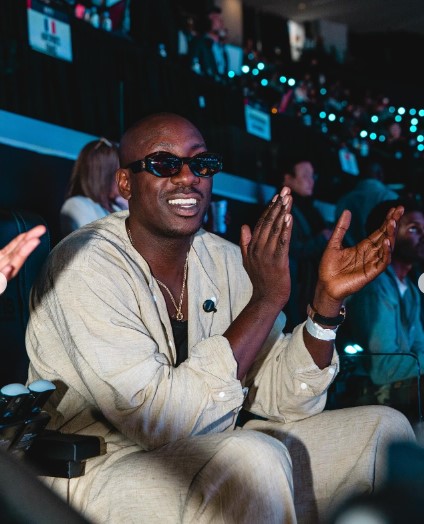
Mwabili’s courts of hope: Former Kwale High School basketball star opens us on the future of the game


NAIROBI
The first thing former Kwale High School basketball star Peter Mwabili tells you is that the game, for him, began with mud.
The real, red, sticky kind that clings to your shoes and your shins and your dreams. The kind that turns a simple bounce pass into a negotiation with gravity. The kind that teaches you, long before any coach does, that if you want the ball to move, you must move with purpose.
It is from that memory, a court that doubled as a swamp after rain, that Mwabili measures the distance Kenyan basketball has travelled. And when he looks at the game today, he sees something stirring, something hopeful, something that feels like a country finally discovering the shape of its own athletic imagination.
Drive through rural Kenya these days and you might catch a glimpse of something unexpected. A backboard nailed to a mango tree, a group of teenagers running drills on a freshly paved court behind a primary school, a ball bouncing in places where basketball once felt like a foreign language.
“Basketball isn’t just in towns anymore,” Mwabili says. “It’s in villages. It’s everywhere.”
There is a revolution happening, a grassroots hum that suggests the sport is a growing cultural rhythm. Clinics are popping up in counties that once had none. Coaches are emerging from communities that once had no one to teach. And the game, once overshadowed by football’s gravitational pull, is beginning to find its own orbit.
Mwabili’s generation played on courts that tested your faith. If the ball didn’t bounce, it meant the heavens had opened. If the lines disappeared, it meant the mud had won. Today’s teenagers, he says, are stepping onto something different… courts that actually resemble courts.
“We used to play in muddy courts,” he recalls. “Now paved courts are being built. Many schools have basketball as a sport, unlike before.” It’s more than infrastructure. It’s a message to a 14‑year‑old in Matuga or Mwatate that their dream is not a joke. That the game they love is worth investing in. And yet, even with smoother courts and wider participation, the path from playground to professional remains a maze with too many dead ends.
Walk into any high‑school tournament in Kenya and you’ll see the raw material. Long‑limbed teenagers with wingspans that whisper possibility, kids who jump like they’re negotiating with the sky, guards with handles that would make a Nairobi matatu driver proud. But talent, Mwabili warns, is not enough. “Clinics and academies will nurture more skills and exposure,” he says. “We need more of them, everywhere.”
Kenya’s basketball story has always been a story of individual brilliance fighting systemic neglect. A story of players who rise despite the odds. Mwabili believes the country is one well‑designed pipeline away from rewriting that narrative.
High schools, he argues, should be the heartbeat of the sport, places where tournaments are frequent, competitive, and taken seriously. Regular, structured competitions that sharpen ambition. “Major tournaments should be laid often,” he says.
Universities, meanwhile, should stop treating basketball as a recreational afterthought and join the major leagues. They should be the bridge between adolescence and adulthood in sport, the place where talent is refined.
It’s a simple idea, but in Kenyan basketball, simplicity is often the most radical proposition. Ask any young Kenyan baller where they want to end up, and the answer is almost always the same. The NBA. The league is both a destination and a myth, a place where possibility and spectacle collide.
Mwabili believes Kenyan kids need to see it up close in arenas. “Kids should be sponsored to attend NBA matches,” he says. “It will inspire them.” He says it with the conviction of someone who knows that sometimes a single moment can alter the trajectory of a young athlete’s life. And when asked whether Kenya can produce an NBA player, he doesn’t hesitate.
“Yes,” he says. “Exposure is very important. Young learners will know early what they need to do.”
The ingredients, which are height, hunger, athleticism, and imagination, are already here. What Kenya lacks is the conveyor belt. In a country where football consumes most of the oxygen, Mwabili argues that basketball offers something uniquely powerful: structure. It gives restless teenagers a place to be, a reason to show up, a community that isn’t defined by tribe or circumstance.
“The biggest take‑home with basketball is it takes kids away from drugs and crime,” he says. “It’s for the better of the country.” Basketball is a sport of lines, plays, repetition, and discipline. It rewards consistency. It punishes chaos. It gives young people a vocabulary for ambition. Mwabili’s blueprint for Kenyan basketball is disarmingly straightforward. Start early, support the poor, and make training a national habit.
Introduce kids to the game before they’re swallowed by other distractions. Provide kits to those who can’t afford them. Run clinics as a rhythm, a pulse that keeps the sport alive. These are not grand gestures. They are foundational ones. And perhaps that’s the point. Kenya doesn’t need a miracle. It needs a plan.
Listening to Mwabili, you get the sense that Kenyan basketball is standing at the edge of something. A step toward coherence, toward ambition, toward a future where muddy courts are a memory rather than a metaphor.
The ball is bouncing in more hands than ever. The courts are smoother. The dreams are louder. And somewhere in a village, a child is learning to dribble on a court that actually lets the ball bounce, a small miracle, and perhaps the beginning of something much bigger.
news@thespokanetimes.com
Copyright © 2026 All rights reserved