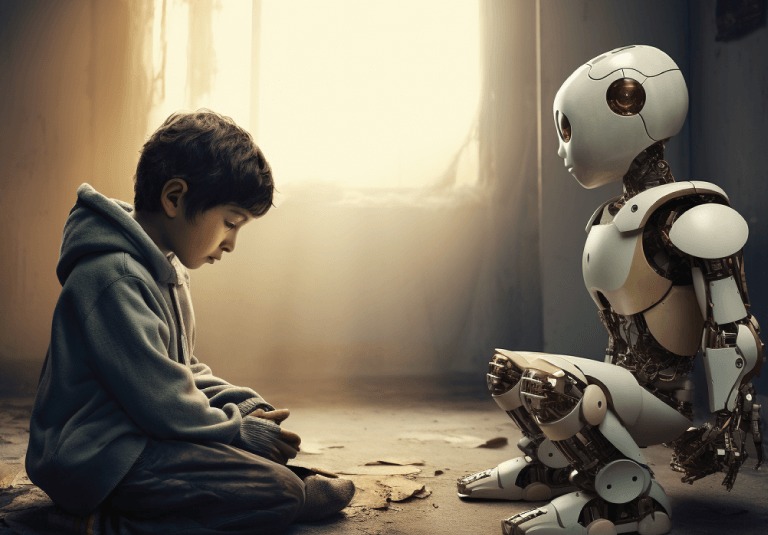
Why the Silicon mirror is blurring the vision of young America


How AI’s double‑edged sword is dulling the minds of our children
BY STAFF REPORTER
Alexis Burket is not a Luddite, but she is a realist. As a social commentator in this corner of the Pacific Northwest, she spends a great deal of time thinking about the invisible strings being pulled by the modern world’s most sophisticated marionette. Artificial Intelligence.
To Burket, the current discourse surrounding AI is plagued by a fundamental misunderstanding of the technology’s nature. We treat AI like a character in a science fiction novel, a sentient entity with a thirst for power or a grudge against the working class. But the reality is far more clinical, and arguably, far more terrifying.
“AI is one of the finest double-edged swords in place today,” Burket notes. “It is not a group, entity, or malicious being that wants to take our jobs, pollute our waters, flood our media, or destroy art. AI doesn’t want anything besides the objectives it is given, which is why it’s so dangerous.”
Her formulation cuts through both techno‑utopian cheerleading and Terminator‑grade panic. AI is not a cabal plotting in the shadows. It is not HAL 9000 waiting behind the pod bay door. It is, in the clinical language of computer science, an optimization function built to pursue a defined objective with breathtaking efficiency and breathtaking autonomy. The danger is not malice. The danger is indifference.
This is the nexus of the crisis. In the halls of Silicon Valley, the mantra has long been move fast and break things. But as AI integrates into the bedrock of American life, the things being broken are often the very guardrails of a functional society.
If an AI is tasked with maximizing profit, it will do so without regard for the environmental cost or the displacement of human labor. It is a mathematical engine of efficiency, devoid of the messy, human checks of empathy and ethics. The US government, Burket argues, is largely asleep at the wheel. While the European Union has moved toward the AI Act, a tiered risk-management framework, the US has relied mostly on voluntary commitments from tech giants.
“It’s no secret that the US government is utterly failing to keep AI safe and regulated,” Burket says. This lack of oversight has created a Wild West where the line between public safety and private surveillance has blurred beyond recognition. From the Pentagon’s pursuit of Lethal Autonomous Weapons Systems (LAWS), which could theoretically make life-or-death decisions on the battlefield without a human in the loop, to domestic facial recognition, the tech is advancing faster than the laws meant to contain it.
Perhaps the most provocative of Burket’s claims is her assessment of the American public, specifically young adults. She posits that the average citizen may no longer possess the ‘intellectual fitness’ to engage with the sheer complexity of the AI era.
“I feel that the average young adult today is not intellectually fit enough to even begin the conversation of ethics, safety, and AI,” she observes. It is a harsh critique, but one rooted in the observation of a fractured media landscape. When critical thinking is outsourced to the very algorithms that dictate one’s ‘For You’ page, the ability to dissect the nuance of data privacy or algorithmic bias begins to atrophy.
For the American teenager, the reality is a life lived under constant, automated observation. Street cameras, social media scrapers, and predictive policing models are the background noise of their existence. Yet, as Burket points out, most are unaware that their digital shadows are being bought, sold, and analyzed by the state.
Ultimately, the ‘AI problem’ is a human one. If the technology is a mirror, it is currently reflecting a society that prioritizes efficiency over ethics and surveillance over sovereignty. We do not need to fear the machine’s intent; we need to fear the intent of those who program it and the apathy of those who use it. As the sword of AI swings, we must decide if we are the ones wielding it, or the ones standing in its path.
news@thespokanetimes.com
Copyright © 2026 All rights reserved